I stumbled across an influencer discussing the value of secondhand belongings. That wouldn’t be a problem if he were real, but instead, he’s the latest example of AI’s power—and how it is changing society.
It used to be simple: whenever new technology comes out, we always hear about the good things it can do for society.
When 5G arrived, the promise was simple: it would enable faster EMS response times and, in turn, save more lives.
3D printing was pitched as a way to make affordable prosthetics for people missing hands or arms.
Virtual reality was pitched as a way to help serious burn victims find comfort in virtual, snow-covered environments.
We usually hear about how new technology will benefit society.
That hasn’t happened with AI—or at least, it doesn’t seem that way.
With AI, it’s not so much about how society can benefit as it is about the losses we’ll face if we don’t embrace it. It’s presented as an arms race, where whoever controls it controls the future. We can either be a part of that future or get left behind.
All the while, AI tech bros give stern warnings about how dangerous their models are, while admitting how little control or understanding they have over them. It’s remarkable.
I’d much rather we go back to talking about how new technology can benefit society and make our lives easier.
With the arms race in full swing, it seems like every day we’re finding more bad uses for AI—ways criminals, fraudsters, and lowlifes can use it to make a quick buck off humanity.
One of those is the world of “AI influencers,” where fictitious experts are created to deceive and profit from the public. The examples below are both real, and prime examples of how this works, so you can make sure you’re taking advice from actual experts.
As someone who lives near Amish and works with estate sellers, both of these examples are massive red flags.
Meet Elias Yoder – An Amish YouTuber Teaching You The Old Ways

Elias Yoder is an alleged Amish man teaching Amish secrets on the world’s most popular video sharing site. His videos get millions of views and promote his digital guide on ‘Amish money-saving strategies.’ You know, regular things they compile and sell in digital format!
Just one thing… this isn’t normal and he isn’t real. Real Amish don’t record themselves with video cameras and become influencers. They don’t sell digital guides and profit off of video ads.
And yet, Mr Yoder’s videos are going viral because people believe and trust that he is Amish. He looks amish, and talks like an Amish. He only needs to sound like how people imagine he would talk like.
So how can you tell he’s fake? It’s a combination of things.
- His videos blatantly copy other creators videos
- His scripts are overly drawn out and full of filler (normal Amish don’t talk like college professors or TED talk presenters, they cut to the chase)
- His maneurisms are repetative (face and characteristics are robotic)
- Frozen posture in each scene (note how his face is always centered squarely with camera and his body never moves)
A common tactic for those who run these fake influencer channels, is copying other creators. Everything from thumbnail to format.

Apparently the Amish are quite comfortable with this, as Eli Yoder copied the same thumbnail to use as his own.

Well look at that. Minor differences.
Meet Malcom Ashby – An Expert Auctioneer Helps You Value Your Stuff
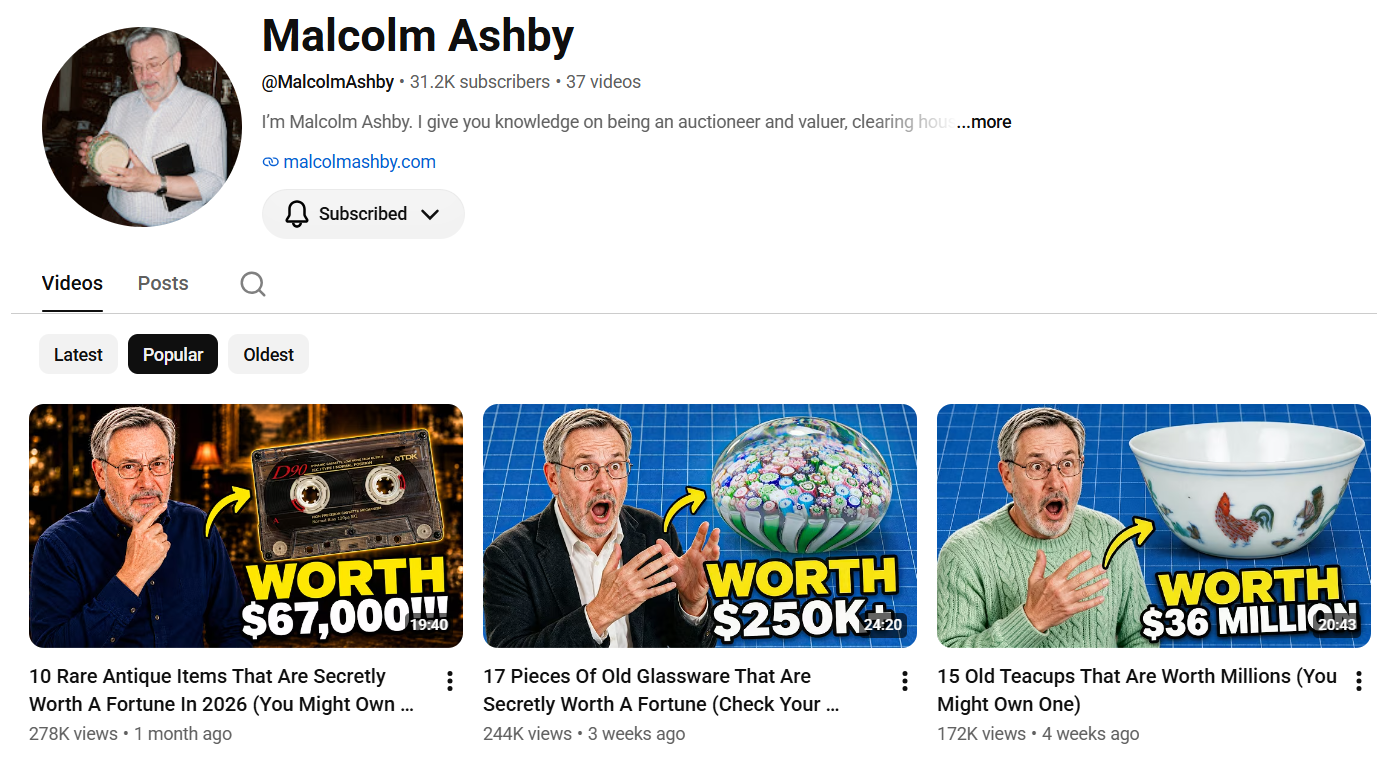
This guy popped on my radar just a few days ago. His videos were recommended by YouTube itself, despite me never having watched similar vids.
Mr. Ashby helps people find treasures in their belongings, using famous examples of people finding incredible fortunes in everyday things. Not exactly a common occurrence, and most estate sellers will tell you it is rare to find significant value in the average persons belongings.
He sells the story that value could be hidden in the attic, and makes his viewers fear throwing anything away until they buy his digital guide.
It clearly works. With 30k subscribers and 100,000’s of view he’s doing just fine. People are watching, and if their watching, they’re probably buying his guide.
His bio is completely believable. An auctioneer who makes videos helping people value their belongings? …That’s believable in this day and age. His age, story, and even accent all make him more believable.
Both influencers are selling guides. It’s very common with fake AI influencers to do this, as no reasonable marketer would ever go through all the trouble producing free content just for the fun of it. It’s all about the money.
One thing I noticed about Mr Ashby, is the video quality of his “talking head” shots are lower quality, almost with a VHS style look. I’m assuming it was done to add authenticity and make it a little more difficult to tell it’s fake.
The biggest tell, just like Mr Yoder, is the mannerisms. Both faces are extremely limited in range of expressions, and formulaic about when expressions are made, with the same expressions used at specific times or specific phrases.
Something like: “Once you see it for yourself, you can’t unsee it.” – Raised brow and head bob.
Chances are you’ve heard that sentence before, it’s a popular one for AI to use. Watch enough of these vids and you’ll pick up on common phrases and know if a human wrote the script.
The Signs of an AI Influencer
A key way to identify fake influencer channels is the script. You’ll hear an authoritarian tone to the point of sounding arrogant, with heavy use of “absolutes” where solutions are presented as being the absolute best.
It’s never “maybe” or “might”, its “will” and “always”.
AI influencers have perfect on camera posture. Their faces are looking squarely into the camera, with subtle expression and head movement that follows a rigid pattern.
A normal YouTuber has variance in their speech and expressions, where for example, they don’t always raise their eyebrows when they say a certain thing or always use a specific tone when delivering a message. In general, a human influencer will have far more variance in their expressions, tone, and word selection than an AI.
In both Mr. Yoder and Mr. Ashby’s you’ll see that their expressions are very limited and repeated across all their videos. They’re too perfect and formulaic.
Their videos are drawn out with repetition. This is because AI video segments are produced in separate chunks, where the AI cannot “remember” what it said in each segment. This leads to it repeating itself over and over to establish context.
AI video is formulaic, rigid, often appearing well produced and thoughtful in that it addresses all concerns you have as a viewer. The speech sounds like an actual speech that’d be delivered to a crowd. Yet somehow, the presenter memorized the entire script and delivered it effortlessly.
Authentic human content will be imperfect, inconsistent, and have more variance in expression and word choice. AI doesn’t break off into tangents, randomly choose unique word choices or phrases, or show any depth or personality across its videos. It’s a copy-cat machine that can only do what others have done before it.
This Will Probably Get Worse
Wish I could say this wasn’t going to be a massive problem down the road, but it is. The amount of money being invested into AI video production is insane. Hollywood production companies are eager to get their hands on tools that can produce entire movies, shows, and trailers in a fraction of time.
Just take a look at what that vision looks like today. This is a AI video generation tool that was used to create this fully generated short film with fake characters.
With tools like this, I think you can see where the world of the fake AI influencer is headed.
…I don’t know about you, but I’m having a hard time getting excited about a future where I can’t tell if someone is real or not.
Fake thrifting, secondhand, and resale influencers was not on my bingo card.