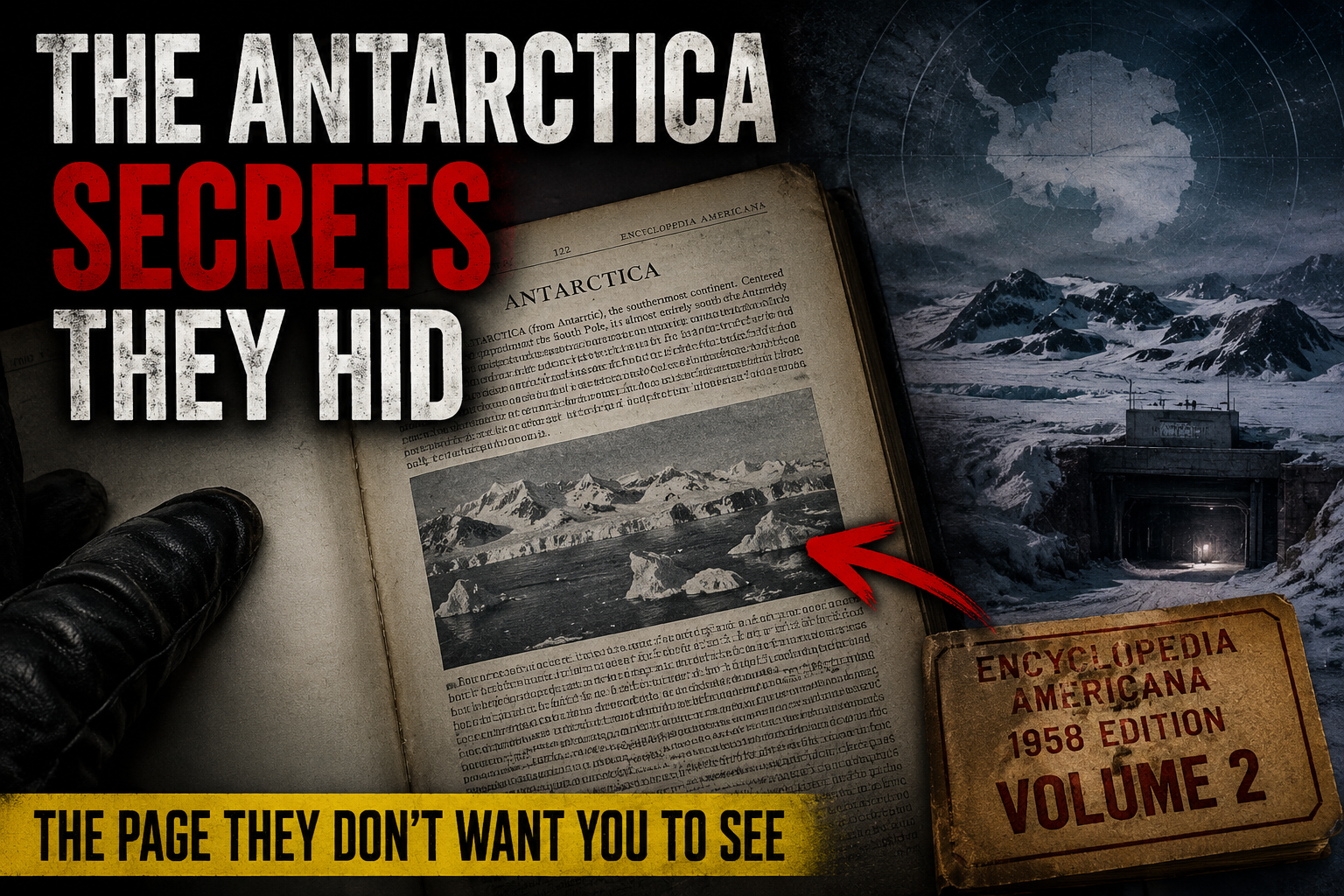
Why are so many people looking up Antarctica in old encyclopedias?
Sellers of vintage encyclopedias—especially mid-century sets like the Encyclopedia Americana or comparable editions of Encyclopedia Americana—are noticing a strange and surprisingly consistent pattern:
One volume keeps getting singled out.
Not Volume 1. Not a complete set.
Volume 2.
And more specifically, Volume 2 sections that cover Antarctica, polar exploration, and early geographic descriptions of the southern continent.
When the 8th message requesting Volume 2 on my 1958 Encyclopedia Americana eBay listing came in, I set out to see if other sellers were getting the same thing.
Find All 1958 Encyclopedia Americana Listings on eBayFor old encyclopedia listings, sellers report:
- repeated requests for “just Volume 2”
- buyers asking for photographs of specific Antarctica pages
- unusually urgent or emotional messages
- interest in very specific passages rather than the book as a whole
At first glance, it looks like normal collector behavior. But the consistency suggests something more structured: a cultural internet phenomenon driven by Antarctica-focused conspiracy communities.
It wasn’t until I saw weekly requests for volume 2, that I realized something was off.
I even asked them what was so special about it, but no one responded.
It wasn’t until someone asked me to take a picture of a specific page in the Antarctica section (so they could compare it to their grandma’s edition to see if they matched… right), that I realized that yes, this was exactly what they were looking for.
Marvelous… but also kind of scary.
Do we live in a world where information is tucked away in old books, slowly disappearing, and all we have is the word of an AI bot?
Yep, I just peed a little.
The Antarctica “Information Hunt” Phenomenon
Antarctica occupies a unique place in modern internet folklore. It is remote, largely inaccessible, heavily regulated under international treaty, and historically under-documented in popular media compared to other continents.
That combination has made it a magnet for speculative narratives.
As a result, older encyclopedias—especially those printed before satellite imagery became common—are treated by some online communities as “time capsule evidence.”
Mid-century volumes are viewed not as reference books, but as:
“pre-digital records of what the world was allowed to say about Antarctica.”
This belief drives targeted purchasing behavior.
Common Antarctica-Related Theories Driving Demand
While these ideas are not supported by scientific or historical evidence, they are widely circulated online and appear to influence buying patterns:
1. The “Ice Wall / Hidden Continents” Theory
Claims that Antarctica is not a continent in the traditional sense, but a surrounding boundary of a larger enclosed world.
Old encyclopedias are sought to:
- compare descriptions of Antarctic geography over time
- identify wording changes between editions
2. “Restricted Treaty Knowledge” Claims
Some communities misinterpret the Antarctic Treaty System as a form of information suppression.
They believe:
- older books contain “less censored” descriptions
- modern sources omit or soften earlier claims
3. Nazi Base / Hidden Military Facility Narratives
A long-running internet theory suggests hidden WWII-era bases or secret operations in Antarctica.
Buyers often look for:
- expedition reports
- Cold War-era references
- early exploration summaries that might mention unusual activity
4. “Lost Civilizations or Structures Under Ice”
Some fringe theories claim Antarctica contains:
- ancient ruins
- pre-human civilizations
- geological anomalies interpreted as structures
Old encyclopedias are viewed as potentially containing “unedited” early interpretations of Antarctic geology.
5. Alien or Non-Human Activity Speculation
A smaller but persistent subset of theories suggests Antarctica is connected to extraterrestrial presence or concealment narratives.
This drives highly specific requests for:
- maps
- expedition logs
- early scientific interpretations of unexplained features
Why Volume 2 Specifically Gets Targeted
The pattern you’re seeing—especially with Volume 2—is not random.
In many 1950s encyclopedia sets:
- Antarctica entries often appear in early alphabetical volumes
- exploration history is grouped near geography entries
- fold-out maps and illustrations tend to be concentrated in those sections
So Volume 2 becomes a “high-value target” for people looking for:
- Antarctic geography text
- polar expedition summaries
- older scientific framing of the continent
In short: it’s the volume most likely to contain what they think they’re looking for.
Shop 1958 Encyclopedia Americana Listings on eBayWhy Buyers Sound “Urgent” or “Concerned”
Messages often feel emotionally charged for a simple reason: within these communities, Antarctica is framed not as a topic of curiosity, but as a topic of concealment or revelation.
That creates behavior like:
- urgency (“I need that exact page”)
- specificity (“page with Antarctica section showing X”)
- repetition (multiple buyers asking similar questions independently)
From a seller’s perspective, this can feel unusual or even alarming—but it is consistent with how online speculative communities interact with physical media artifacts.
What This Means for Sellers
For vintage encyclopedia volumes, especially those from mid-century print runs like the Encyclopedia Americana, demand is no longer purely academic or decorative.
It now includes:
- collectors
- designers
- archivists
- and niche internet research communities
This creates uneven demand across volumes, with Antarctica-heavy sections becoming disproportionately sought after.
Pricing Insight: Why Volume 2 Commands a Premium
First off, I want to pre-empt this with a disclaimer. Often, people get overzealous with pricing just because they see people want something. The goal here isn’t to drive market prices up or grift buyers. When it comes to encyclopedia sets, many buyers looking for a single volume will pay extra just so they don’t have to buy an entire set. The catch is, when a set-owner sells a single volume, they get stuck with a ton of volumes no one wants, which means they’ll never be able to sell the set for the full sets value.
In this case, selling a single volume for $20, effectively kills the value of a $200 complete set. The seller has lost out on $180… and likely will have to pitch the rest. In fairness, the best price is one that makes sense to both the seller and the buyer, and satisfies demand.
Because Volume 2 is:
- repeatedly requested (no joke, weekly requests)
- difficult to replace individually
- tied to specific high-demand subject matter
- and often more heavily inspected than other volumes
it behaves less like a “book volume” and more like a targeted informational artifact in the resale market.
A reasonable pricing approach in this niche is:
- If a full set sells at a baseline value (let’s say 100% of set price)
- Individual high-demand volumes (like Volume 2) often justify ~50% of full-set value on their own
Given repeated inquiries, urgency of requests, and topic-specific demand, a standalone listing price around:
$100 for Volume 2
is defensible within this niche market—not because of intrinsic encyclopedic value alone, but because of concentrated buyer demand around a specific subject area.
Do you have to charge $100 -absolutely not. But keep in mind, the rest of the set is now almost worthless. You might sell volume 1 and 3 for $19.99, but you will almost guaranteed, sit on the rest for years until people care.
You should be happy about this price, because hey, at least you get something now. It’s a quicker sale and an easy ship vs shipping a huge heavy set no one wants. Full sets can take years to sell.
Now you know the secret encyclopedia volume everyone seemingly wants.
The Message That Changed My Understanding
Initially, I assumed the unusual demand for Volume 2 was driven entirely by internet conspiracy theories about Antarctica. You know, alien bases and stuff.
Then I received a message from a prospective buyer:
“Hello. Can you please take a picture on the definition of Antarctica and send it to me. I wanna see if it matches my grandmother’s and if so, I will buy it.”
That request changed how I viewed the phenomenon.
The buyer wasn’t asking whether the encyclopedia contained secret information. They weren’t asking about hidden bases, lost civilizations, or military operations.
They wanted to compare a specific definition with another physical copy.
That detail reveals something important: many buyers appear to be treating old encyclopedias as historical reference artifacts rather than simply collectible books.
In the digital age, information changes constantly. Websites update. Search results shift. Articles are revised. By contrast, a printed encyclopedia represents a snapshot of what was believed, accepted, or published at a specific moment in time.
For some buyers, that makes a 1958 encyclopedia valuable not because it contains secret knowledge, but because it cannot be edited after the fact.
The request to compare my encyclopedia against a grandmother’s copy suggests another possibility. Buyers may be looking for:
- Differences between printings
- Differences between encyclopedia publishers
- Changes in geographic descriptions over time
- Historical wording that disappeared from later editions
- Confirmation that a family copy contains the same text
This type of comparison behavior is common among book collectors, archivists, and historical researchers. However, Antarctica appears to attract a unique level of attention because it sits at the intersection of exploration, geopolitics, scientific discovery, and internet folklore.
In other words, the buyer may not have been searching for a conspiracy at all.
They may simply have been searching for consistency.
Ironically, that search for consistency may be exactly what fuels many of the Antarctica discussions found online today. People compare maps, encyclopedia entries, expedition reports, newspaper articles, and government publications, looking for discrepancies that they believe are significant.
Sometimes those discrepancies are meaningful.
Often they are simply the result of different editors, different publication dates, or changing scientific understanding.
Either way, the demand is real.
And for sellers of vintage encyclopedias, Antarctica-related volumes continue to attract an unusually high level of interest compared to the rest of the set.
But… what if I’m wrong?
The Question Nobody Explained
The more I thought about the buyer’s message, the less interested I became in Antarctica itself.
Instead, I became interested in the question.
Why did they want to compare the definition?
Not the maps.
Not the photographs.
Not the condition of the book.
Not even the entire article.
The definition.
That detail stuck with me.
If someone simply wanted information about Antarctica, modern sources are abundant. A search engine can return thousands of pages in seconds. Scientific organizations publish enormous amounts of data. Satellite imagery is readily available.
So why seek out a 1958 encyclopedia?
And why compare its wording to another copy?
Perhaps the explanation is completely ordinary. Maybe they were replacing a family set. Maybe they were researching how geographical definitions changed over time. Maybe they were simply curious.
But perhaps there is another possibility.
What if they already expected to find a difference?
The request wasn’t:
“What does your encyclopedia say about Antarctica?”
The request was:
“Does it match?”
That wording assumes there is something worth comparing.
Something worth verifying.
Something worth confirming.
Whether the buyer was a collector, researcher, skeptic, conspiracy enthusiast, or simply a curious reader, the same question remains:
Why the HELL have so many asked for this edition, and what were they expecting to find?
And if they found one, what would it have meant to them?
I don’t have the answer. I sold it within 1 day of listing the volume for $27. He asked me to list it individually, and I even made a mistake on the listing and ended up charging for shipping… which I said was free.. it was supposed to be $19.99. He bought it anyway minutes after I messaged him it was live and said it was ok. You can confirm here for yourself.
In fact, that’s what makes the experience so fascinating.
As sellers, we often assume people are buying objects.
But sometimes they’re buying questions.
Sometimes they’re buying evidence.
Sometimes they’re buying confirmation.
And sometimes they’re chasing a mystery that only makes sense to them.
The next time someone asks for a specific page from an old encyclopedia, it may be worth asking yourself:
Are they looking for information?
Or are they looking for reassurance that something they already believe is true?
The answer may reveal more about the buyer than it does about the book.
CONFIRMED? A Reader Offers an Explanation
After publishing my observations, an eBay user reached out with what they believed was the reason behind the unusual demand.
They wrote:
“Folks are looking for the Encyclopedia Americana 1958 volumes that cover Antarctica. They are seeking to have a physical copy o/ evidence of what is specifically stated to exist at latitude 85 south longitude 50 west. There are two 1958 versions, only the first has the information. That said – I don’t think it gives the evidence desired. There are many other better sources, especially from Russian sources.You can get a brief intro to the subject here if you are interested: https://youtu.be/X8H0Mdm9iu0?t=623”
I watched the video and have to say I get why people want answers. There’s not exactly a whole lot of information about Antarctica, and often in school it’s talked about as this big uninteresting frozen wasteland only scientists get to go to, but really, it’s this massive territory we are actually restricted from visiting.
This is exactly the kind of thing people have a right to be desperate to know about. These are people exercising their right to intellectual freedom.
Going back to the message, I found it interesting for two reasons.
First, it offers a possible explanation for why multiple buyers have specifically requested the Antarctica section rather than the encyclopedia as a whole. If there really are collectors or researchers attempting to compare different printings of the 1958 edition, it would explain the unusually focused interest in a single volume.
Second, the message reinforces the broader theme of this article: people are searching for historical reference material and comparing physical sources. Regardless of their conclusions, the common thread appears to be a desire to examine older printed records for themselves rather than relying solely on modern summaries.
The reader also suggested a video discussing the topic. I watched it diligently, and found it was indeed a “flat-earther” video. All I’ll say about that is if you don’t know what that is, then you’ve got quite the rabbit hole to go through.
What remains undeniable is the marketplace behavior itself. Over time, I’ve received repeated inquiries centered on the Antarctica entries in a 1958 encyclopedia—far more than for any other subject in the set.
Whether those buyers are collectors, historians, skeptics, or simply curious readers, their interest has transformed what would normally be an ordinary reference volume into one of the most sought-after books in the collection.
Sometimes the most interesting part of selling old books isn’t what’s printed on the page.
It’s discovering why people suddenly care about reading it.
Takeaway
Today, what looks like a simple encyclopedia sale pattern is actually a small intersection of:
- vintage media collecting
- algorithm-driven search behavior
- and niche internet folklore communities focused on Antarctica
- tangible answers
The result is predictable:
certain volumes become disproportionately valuable based on what they contain—not just what they are.
I hate that its come to this, but one thing I can say: because of AI, encyclopedias just got a whole lot more valuable.