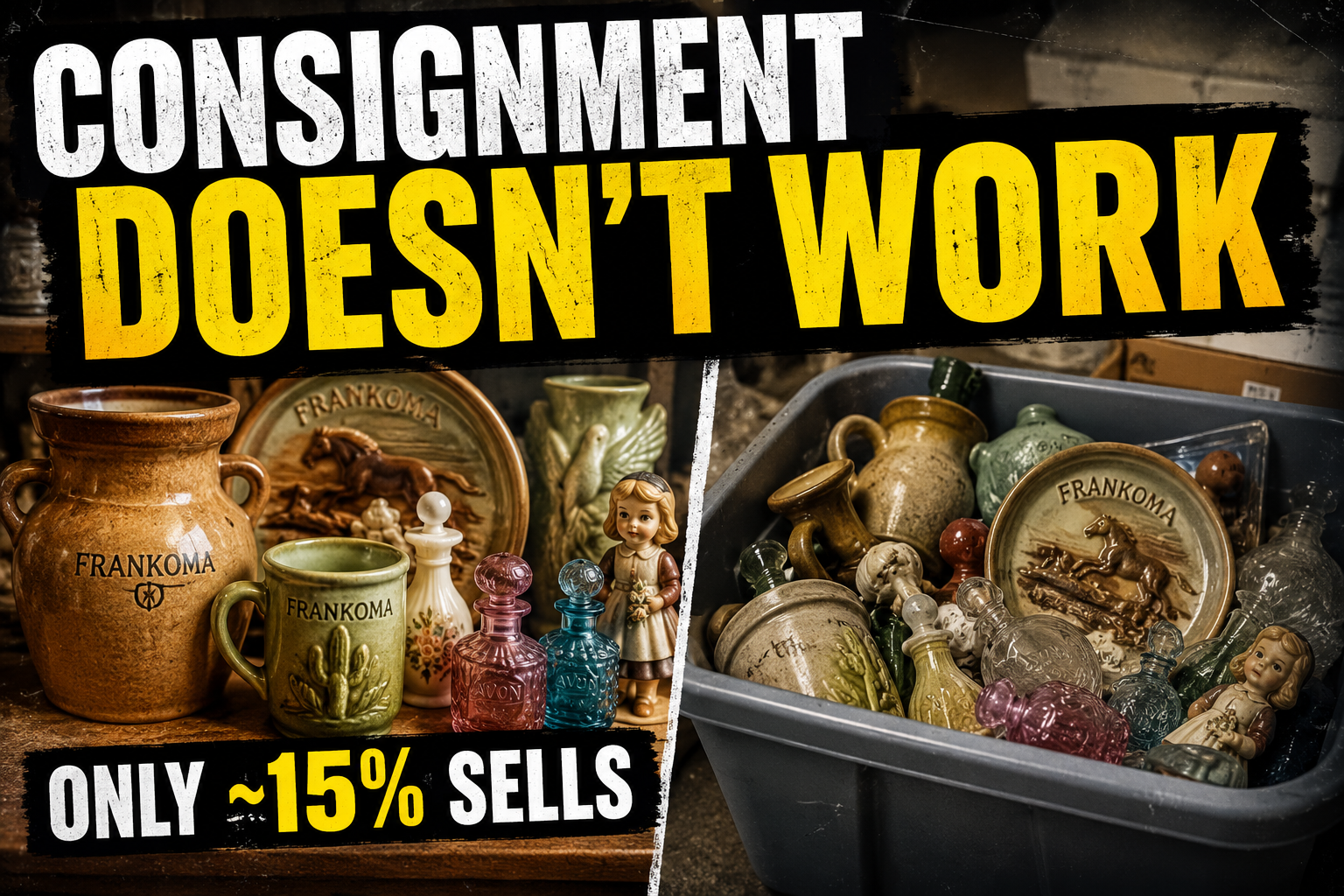
We get asked all the time:
Do You do Consignment?
While it used to be a yes, now?
No — and there’s a reason for that.
If you’ve ever tried to sell on eBay yourself, you already understand why. If you haven’t, this post will give you a clear picture of what actually works in today’s algorithmic market—and what doesn’t.
Let’s summarize the problem first, and then get into the gritty details.
The Core Problem With Consignment on eBay
This is just a brief summary, but when you strip everything down, consignment on eBay doesn’t fail for one reason—it fails because of a stack of compounding pressures.
Those pressures fall into four core areas:
1. Margin vs. Effort
Consignment dramatically increases the work per item:
- Intake and evaluation
- Listing, photography, and research
- Communication with consignors
- Payout tracking
At the same time, it cuts the reward in half (or worse).
Add in:
- eBay fees
- Promoted listing costs
- Shipping and returns
…and the remaining margin often isn’t enough to justify the effort.
More work, less pay—that’s the fundamental imbalance.
2. Control vs. Constraint
eBay rewards sellers who can move fast and adapt:
- Adjust pricing quickly
- Accept offers
- Run promotions
- Liquidate slow inventory
Consignment introduces friction into all of this:
- Pricing disagreements
- Emotional attachment to items
- Approval delays
Without full control, items sit—and sitting inventory kills performance.
You can’t compete in a fast market with slow decision-making.
3. Volume vs. Quality
Consignment doesn’t produce clean, consistent inventory.
Instead, it brings:
- Mixed-quality items
- Slow-moving or niche goods
- Leftover or cherry-picked inventory
This leads to:
- Lower sell-through rates
- More storage pressure
- Reduced profit density
In contrast, successful sellers prioritize:
- Fast-moving items
- Consistent categories
- High turnover
Not all inventory is equal—and consignment rarely brings the best of it.
4. Market Reality vs. Human Expectation
This is where most consignment deals break down.
The market says:
- Only ~15% of items sell in 30–60 days
- Prices are driven by competition
- Many items take time—or never sell
But expectations are often:
- “This should sell quickly”
- “It’s worth more than that”
- “Let’s wait for a better price”
That gap creates:
- Friction
- Delays
- Frustration on both sides
Consignment doesn’t just fight the market—it fights human nature.
The Bottom Line
Consignment struggles on eBay because it creates tension in every direction:
- Lower margins
- Slower decisions
- Weaker inventory
- Misaligned expectations
Each issue on its own is manageable.
Together, they make the model extremely difficult to sustain without strict structure—higher commissions, full control, and defined timelines.
Without those, the system doesn’t bend.
It breaks.
If you want to better understand these reasons, keep reading.
Why Traditional Consignment Doesn’t Work on eBay Anymore
Consignment used to make sense in slower, simpler marketplaces. eBay today is not that environment.
It is highly competitive, algorithm-driven, and increasingly pay-to-play.
1. eBay Rewards Specialists — Not Generalists
eBay’s search system favors sellers who:
- List consistently
- Sell within a focused niche
- Maintain strong sell-through rates
A consignment model brings in random, inconsistent inventory, which weakens all of those signals.
That means:
- Lower visibility
- Slower sales
- More reliance on paid promotion
2. You’re Competing Against Experts
Specialized sellers know:
- Exact pricing ranges
- What sells fast vs. what sits
- How to optimize listings for search
They also often source inventory cheaply, which allows them to accept thinner margins.
A consignment seller?
They’re working with random unknown items, unknown value, and shared profits—a built-in disadvantage.
In this day-and-age, eBay only shows sales history for items it wants to show—and typically that means you will only see items that sold for higher than market value. This is bait for inexperienced sellers. Any experienced seller knows this.
3. Fees Have Changed the Game
Modern eBay selling isn’t just “list and wait.”
You’re dealing with:
- Final Value Fees
- Shipping costs
- Returns
- And increasingly… Promoted Listings
Many sellers now spend an extra 10–15% of the sale price just to get visibility.
That means a typical sale might look like:
- 15% eBay fee
- 10–15% ad spend
- Shipping + materials
Before profit is even considered.
An 8% cost increase for shipping is expected to go into effect in the near future. With margins already being low, this is yet another nail in the consignment coffin. The last thing any consignment seller wants to do, is talk about how 50% is not enough, and that 60% is the new norm…
4. The Margin Splitting Problem
Now add consignment into that equation.
Let’s say an item sells for $40:
- Fees + ads take a large cut
- Shipping and handling take more
- Then the remaining amount is split
Story time!
I once bumped into a Gen-X’er who inherited his parents home, full of china and other things.
He was convinced I would be able to sell his items at 30%.
I played with it, and recommended we start with 50 items and see how it goes. I recommended that because a trial run is the only way to tell if they are serious. It shows you what they are willing to give you, and what the future holds. If they bring the best items they are a great client. At 30% it’s imperative they bring quality items.
But here’s the reality: at a 30% commission, the seller often ends up making less than minimum wage for their time.
That’s not sustainable—and it’s why low-percentage consignment models quietly fail.
So today, 50% is the norm, and yet, like said above, it’s only going to go higher… consignment on eBay is on its last legs.
5. Consignors and Market Reality Often Clash
This is the hardest part.
Most people expect:
- Higher prices
- Faster sales
- Less discounting
But eBay reality is:
- Competitive pricing wins
- Price reductions are normal
- Some items simply don’t sell
Add emotional attachment into the mix, and pricing becomes even harder to align with reality.
Let’s pause for a moment, and go back to the good-old-days where eBay consignment stores were everywhere.
When Physical eBay Stores Were Everywhere (And Consignment Actually Worked)
There was a time—roughly the early to mid-2000s—when eBay consignment wasn’t just viable, it was everywhere.
I remember this time. I was a teenager, and every family trip took us through a city that had an eBay consignment store.
When I was in college, EVERY Entrepreneur magazine featured eBay selling as THE business of choice.
There was a feature about a multi-millionaire selling model trains. That was the thing back then!
What It Looked Like
You’d see:
- Local “eBay drop-off stores” in small towns and cities
- Businesses built entirely around selling items for others
- Simple commission models (often 20–30%)
- Walk-in traffic from people looking to offload valuables
For a while, it worked.
Why It Worked Back Then
Several conditions made consignment viable in that era:
1. Less Competition
There were fewer sellers, fewer optimized listings, and less pricing pressure.
2. Simpler Fee Structure
Fees were lower, and advertising wasn’t required to get visibility.
3. Auction Culture
Many items sold via auction, which:
- Reduced pricing disputes
- Let the market “decide” value
- Created excitement and urgency
4. Information Advantage
Most people didn’t know how to sell online, so consignors provided real value just by listing items properly.
What Changed
Over time, all of those advantages disappeared.
eBay shifted from auctions to fixed-price competition
Now you’re competing directly against thousands of listings—not bidding wars.
Fees increased
Final value fees grew, and costs became more layered.
Advertising became necessary
Promoted listings are now a major factor in getting visibility.
Sellers became more sophisticated
Specialists dominate categories with optimized listings, data-driven pricing, and high-volume workflows.
Online selling became accessible to everyone
The “knowledge gap” that consignors relied on largely disappeared.
How It Fell Apart
Those local eBay consignment stores didn’t slowly decline—they disappeared fast.
Why?
Because the math stopped working:
- Lower margins
- Higher effort per item
- More competition
- More unsellable inventory
At the same time, consignors still expected:
- High prices
- Low commissions
- Guaranteed results
That mismatch killed the model.
Is eBay to blame? I don’t know. But what I do know is they tried up until 2020 to keep consignment on their platform alive, even interviewing consignment sellers on their eBay For Business podcast. But then… it vanished without a trace. It seemed they realized themselves the gig was up.
Today, there’s still a small consignment seller community on life-support, but year after year, they must explain to their clients why they have to charge a higher commission.
If they do business with you, it’s because you have something that is clean, pristine, valuable, and ready to list.
Now, let’s get to the biggest reason why modern consignment fails.
The Reality of Sell-Through Rate (And Why the “Keep Clause” Exists)
This is something sellers don’t tell you.
One of the most misunderstood parts of selling on eBay is something most people have never even heard of:
Sell-through rate.
In simple terms, it’s the percentage of listed items that actually sell within a given time frame.
What the Numbers Look Like
Based on internal tracking and self-reported data from other sellers, a reasonable working estimate is:
~15% of items sell within a 30–60 day window
That means:
- Out of 100 items listed
- Roughly 15 will sell
- And 85 will sit
Not forever—but long enough to create real cost, effort, and drag on a business. They take up space, time, and ultimately reduce earnings. If you are business minded, this is called Profit Density.
Profit Density: Why Some Items Aren’t Worth the Space
Another concept most people don’t think about is something we call:
Profit density.
It’s simple:
How much profit an item generates relative to the space and time it takes up.
A Real-World Example
Let’s compare two scenarios.
Scenario A: 100 Small Items
- 100 items (DVDs, small collectibles, etc.)
- Each sells for $10
- Total sales: $1,000
- They sell steadily over 30–60 days
- Stored efficiently in bins or shelves
Scenario B: 1 Large Item
- 1 large collectible (furniture, bulky decor, etc.)
- Sells for $1,000
- Takes up the same physical space as those 100 items
- Takes 3–6 months (or longer) to sell
On Paper, They Look Equal
Both scenarios generate:
- $1,000 in sales
But in reality, they are not equal at all.
What Actually Happens
The 100 smaller items:
- Sell faster
- Create consistent cash flow
- Improve sell-through rate
- Keep your store active in the algorithm
The 1 large item:
- Sits for months
- Blocks valuable storage space
- Ties up time and attention
- May require price drops to finally sell
The Key Difference
The smaller items are more profit-dense.
They generate:
- More activity
- Faster returns
- Better use of space
Even though the total sales number is the same.
Why This Matters for Consignment
Consignment often brings in:
- Large
- Slow-moving
- Hard-to-ship items
- Or “special” items expected to bring high value
But these items are often:
Low profit-density.
That means:
- They sit longer
- They take up space
- They delay cash flow
- And they increase risk
The Hidden Danger
If a seller fills their space with low profit-density consignment items:
- Their inventory slows down
- Their sell-through rate drops
- Their cash flow tightens
- Their business becomes less efficient
Even if those items eventually sell.
Why Sellers Prioritize Density
Successful sellers don’t just chase price—they optimize for:
- Speed
- Volume
- Turnover
- Space efficiency
Because in the long run:
Faster, smaller, consistent sales outperform slow, bulky “big wins.”
Bottom Line
Just because an item could sell for a high price doesn’t mean it’s a good item to take on.
If it takes up too much space and moves too slowly:
It’s not just low-performing—it’s actively holding your business back.
What “Sitting” Actually Means
Unsold inventory isn’t free.
Each item that doesn’t sell still requires:
- Time to photograph and list
- Storage space
- Organization and tracking
- Periodic relisting or price adjustments
It also affects overall store performance:
- Lower sell-through rate
- Slower cash flow
- Reduced visibility in search
In other words, the 85% isn’t neutral—it’s expensive.
Why the Keep Clause Is Necessary
Now apply that reality to consignment.
If a seller takes in 100 consigned items:
- ~15 sell within the target window
- ~85 do not
Without a keep clause, the outcome looks like this:
- The seller does 100% of the work
- Only gets paid on 15 items
- Then returns the remaining 85 items
That model simply doesn’t work.
The Hard Truth: Most Consigned Items Won’t Sell Quickly
Because of this, a keep clause (typically 45–90 days) is essential.
Once an item passes that window:
- It has already been tested at market price
- It has consumed time and resources
- It has proven to be slow-moving
At that point, the seller keeps the item to offset the effort invested.
What This Means for Consignors
This is where expectations need to match reality.
Using that same 15% sell-through estimate:
It is entirely possible that a large portion—sometimes the majority—of consigned items will not sell within the consignment window.
And in those cases, those items become the seller’s inventory.
That’s not a trick or a loophole—it’s the mechanism that makes the model viable at all.
Slow Economies Make This Even More Pronounced
In a slower economy:
- Buyers become more selective
- Discretionary spending drops
- Items take longer to sell
Which means:
- Sell-through rates decline
- More items miss the sale window
- More inventory rolls into the “keep” category
So paradoxically, during tougher markets:
Consignors are more likely to lose items to the keep clause—not because anything is wrong, but because demand has slowed.
Why This Matters
Consignment isn’t just about selling—it’s about risk distribution.
- The seller takes on labor, time, and platform risk
- The consignor takes on the risk that the item may not sell quickly
The keep clause is where those risks balance out.
Without it, the model becomes one-sided—and eventually collapses.
Bottom Line
If you’re considering consignment, the most important thing to understand is this:
Listing an item does not mean it will sell—especially not quickly.
And any consignment model that doesn’t account for that reality is setting both sides up for frustration.
Why People Still Think Consignment is an Option
Even though the landscape has changed, the perception hasn’t.
People remember:
- “You used to be able to take stuff somewhere and they’d sell it for you”
- “It’s just listing items online, right?”
- “30% commission sounds fair”
What they don’t see is what selling on eBay actually requires today:
- Constant pricing adjustments
- Promotion management
- Inventory turnover pressure
- Thin, competitive margins
The Reality Today
Modern eBay selling is closer to retail operations than casual reselling.
It requires:
- Speed
- Volume
- Specialization
- Margin discipline
The old consignment model was built for a slower, less competitive platform.
That platform doesn’t exist anymore—but the expectation still does.
What Modern Consignment Actually Looks Like
For consignment to work today, the structure has to reflect the real economics of eBay.
That means:
1. Minimum 50% Commission
This isn’t arbitrary—it’s survival.
A 50% split allows the seller to cover:
- Platform fees
- Advertising
- Labor
- Storage
- Risk
Without this, the model breaks down quickly.
2. Full Pricing Control
To compete, the seller must be able to:
- Adjust pricing based on market demand
- Run promotions
- Accept offers
- Liquidate slow inventory
Without flexibility, items sit—and sitting inventory helps no one.
3. A Keep Clause (45–90 Days)
This is the part most people aren’t used to—but it’s essential.
If an item doesn’t sell within a defined window (typically 45–90 days):
- It has already consumed time, labor, and listing resources
- It has likely been tested against the market
- It is now part of long-tail inventory
At that point, the seller keeps the item.
Why?
Because otherwise:
- The seller absorbs all the effort and risk
- The consignor loses nothing
- The model becomes one-sided and unsustainable
Why We Don’t Offer Consignment
After working through these realities, the conclusion is simple:
Consignment only works under strict conditions—and those conditions don’t align with what most people expect.
Rather than create friction, mismatched expectations, and poor outcomes for both sides, we’ve chosen a different path.
What We Do Instead
We focus on:
- Buying inventory outright
- Specializing in physical media
- Moving items efficiently at market-driven prices
This allows us to:
- Price competitively
- Sell faster
- Maintain consistency
- Avoid unnecessary overhead
And ultimately, it creates a better experience—for everyone involved.
If You’re Considering Consignment
Here’s the honest takeaway:
If someone is offering:
- Low commission (20–30%)
- Full control to the consignor
- No time limits
…it’s only a matter of time before the model breaks.
Modern eBay selling requires:
- Speed
- Flexibility
- Margin discipline
Without those, items don’t move—and sellers burn out.
What We’ll Cover Next
If you’ve made it this far, you probably understand the core issue:
Consignment doesn’t fail because people are doing it wrong—
it fails because the expectations don’t match how eBay actually works today.
But that raises the next logical questions:
- When does consignment actually make sense?
- What kinds of items are worth consigning—and which aren’t?
- What does a modern, realistic consignment process look like step-by-step?
- How do payouts actually break down after fees, ads, and shipping?
- Why might selling your items outright be the better option?
- And what happens if you try to sell everything yourself?
In Part 2, we’ll break all of that down.
We’ll look at:
- The small percentage of items that are actually good candidates for consignment
- A real-world comparison between consignment vs. selling outright
- A full walkthrough of the process, from intake to final outcome
- How physical media fits into this equation (and why it’s not as simple as it seems)
- And how to set realistic expectations before you decide what to do with your items
Because at the end of the day, this isn’t about saying “no” to consignment—
It’s about making sure that whatever path you choose,
you’re not walking into it with the wrong expectations.
This will all be covered in our next post.
Final Thoughts
Consignment isn’t “dead”—but it has changed.
Today, it only works when:
- The seller has control
- The margins make sense
- The risk is shared
- $100+ value items (pristine, ready to sell & easy to ship)
- Specialized consignor
If you’re looking to sell, we’re always happy to take a look—and make a fair offer upfront.
If you’re still hopeful about consignment we’ll tell you exactly when it makes sense in part 2. Stay tuned.